

From eucalyptus monocultures to visual arts and permaculture. Coming full (living) circle
Field notes from the Free Radicals residency in Portugal, where art and permaculture met as companion species—testing how their entanglement might nurture community amid capitalism-fueled inertia.

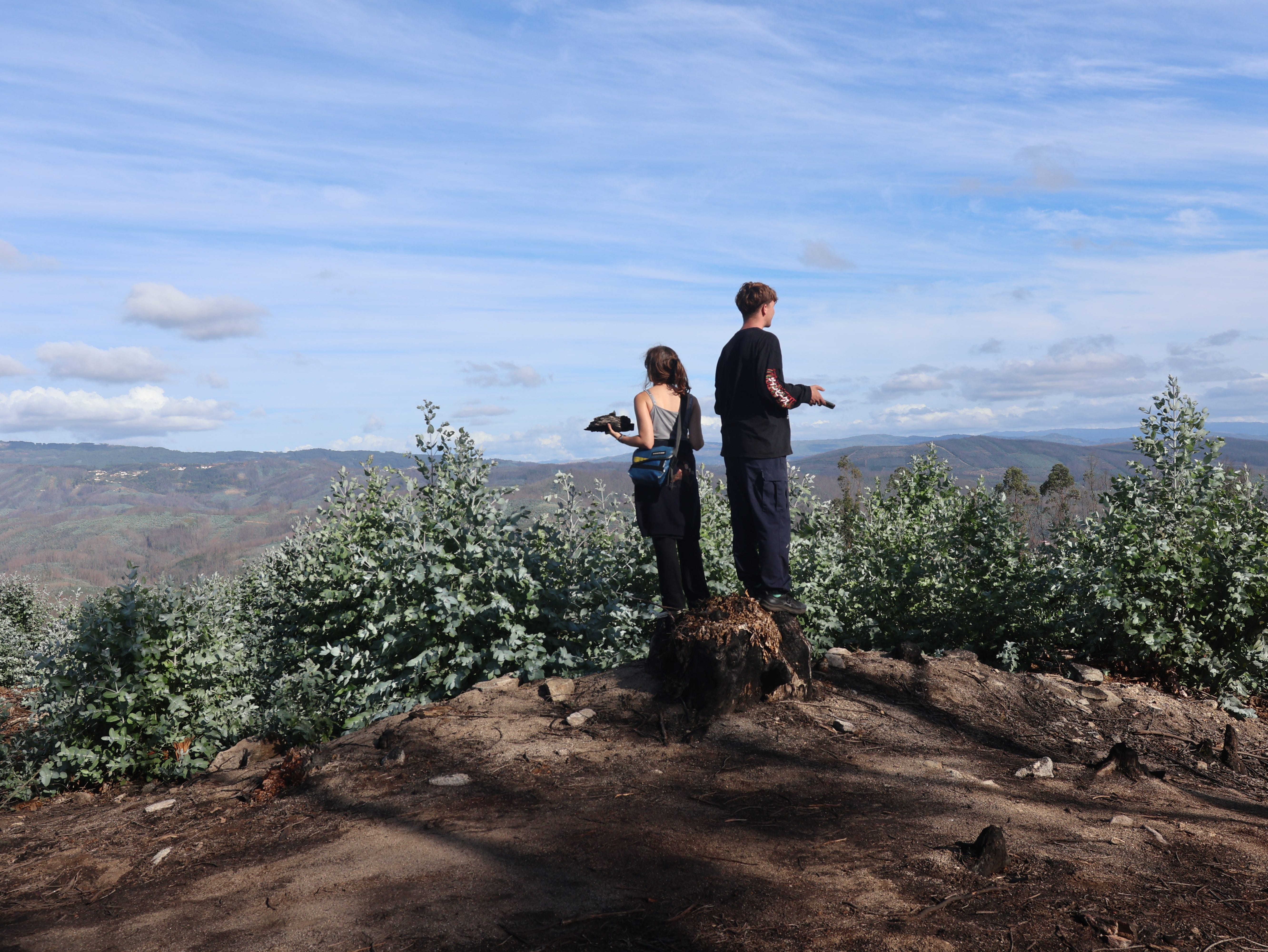
The Portuguese chapter of the Free Radicals journey begins not far from the shores of the Atlantic Ocean. Near the city of Albergaria-a-Velha lies Quinta das Relvas, a small artist-led sanctuary sandwiched between the vast eucalyptus plantations that now cover around 80% of the region’s surface.
The rolling hills of central Portugal are cloaked in the fast-growing, water-hungry trees that now dominate the country’s forestry and paper industries. Cultivated primarily for pulp production, Eucalyptus globulus has become a cornerstone of the global toilet-paper supply chain, and Portugal stands among Europe’s leading exporters. But in the context of the ever-increasing temperatures and biodiversity loss, these monocultures pose a growing threat: thanks to the high amount of essential oils they contain, eucalyptus wood burns fast and fiercely, turning entire regions into a giant tinderbox, ready to be set on fire at the slightest spark.
Like many species later branded as invasive, the eucalyptus is less a culprit than a witness to human recklessness. It first reached Europe in 1774, when seeds of Eucalyptus obliqua collected in Tasmania during James Cook’s second voyage were planted in the greenhouses of Kew Gardens, through the networks of Sir Joseph Banks, then president of the Royal Society and architect of the British Empire’s expanding botanical enterprise. From Kew, Banks distributed further seeds—among them E. globulus—to royal gardens and scientific correspondents across Europe. In Portugal, eucalypts were planted south of Vila Nova de Gaia as early as 1829, expanding rapidly by 1852 under the Baron of Massarelos. Their growth was favoured by a climate similar to Tasmania’s, and within decades the species had become the backbone of Iberia’s pulp and paper industry, turning a colonial curiosity into the region’s dominant resource.
Quinta das Relvas, a family estate passed down through generations of Beatriz Manteigas’s family, is now home to an association founded in 2016 by Manteigas, a visual artist, and António Trindade, an educator and permaculture expert. What began as a modest decision to leave Lisbon and reclaim a more tangible relationship with land has evolved into one of Portugal’s most vital grassroots platforms for ecological learning and artistic experimentation.
By combining visual arts and regenerative systems thinking, Quinta das Relvas proposes novel approaches to sustain community life while restoring balance to its ecosystem. Can permaculture offer an alternative to monocultures? When a plant’s presence is the symptom of a systemic wound—colonial extraction, industrial forestry, climate crisis—can its repurposing as an art object or design product ever be disentangled from the same circuits of profit and prestige that caused the wound in the first place? And how might the arts help make these challenges visible—both to local residents and to international visitors who come here to learn, exchange, and imagine new ways of living with the land?
Listen to Beatriz and Antonio as they explain how combining visual arts and permaculture offers new ways of understanding the challenges related to eucalyptus monocultures. This interview is in Portuguese. The English version will appear in the Free Radicals toolkit, published later next year.
In September 2025, six artists were invited to Quinta das Relvas for a 20-day residency that responds directly to this tension—between economic gain and environmental resilience. Over the course of nearly three weeks, Adam Kvaček, Alejandra Díaz-Guerra Acedo, Inês Quente, Joana Manaia, Maria Ilieva, and Ricardo Nugra Madero came together at Quinta das Relvas to explore how their fields of interest—research-led design, mycelium, photography, participatory interventions, scent, and sound—might intersect and learn from one another, as well as from the principles of art and permaculture.


The residency opened with a session led by Beatriz Manteigas and Noemi Ferreira, introducing the story of the Quinta: its beginnings as a family farm, its transformation into an educational space, and its ongoing attempt to bridge art and ecology. This conversation outlined the principles that guide their work — learning by doing, cooperation across disciplines, and building resilience through community. The following day, António Trindade led a more hands-on introduction to permaculture, shifting from theory to soil. Participants observed the farm’s systems — composting, water capture, seed preservation — and discussed how regenerative design might counterbalance the logic of monoculture that surrounds the region.
A series of workshops encouraged participants to explore the potential of plants as materials and collaborators. Foraging wild species, extracting pigments, and creating inks through individually mentored experiments. Transforming gathered fibres into sheets of handmade paper. Expanding the scope toward bioplastics and the reuse of residues from previous experiments. Each act of making became a reflection on waste, transformation, and value.


Learning continued beyond the farm’s boundaries. Guided by Beatriz, the group walked to the nearby archaeological site — the first elevation from the sea — now framed by the charred remains of a recently burned eucalyptus forest. Further walks led through these plantations, where discussion turned to local customs, forestry economics, and the fragility of a landscape dominated by a single species. The path eventually descended to the river and Pinto’s Bridge, long abandoned, its access erased by heavy machinery.


The residency also extended beyond Branca. During a study visit to Lisbon, participants explored Casa da Cerca – Contemporary Art Center, guided by Sílvia Moreira, through its botanical garden dedicated to plants used in art material production. Later at the Calouste Gulbenkian Foundation, writer and curator Yasmine Ostendorf-Rodríguez led a workshop inspired by her book Let’s Become Fungal!, followed by a lecture introducing Mycelium Teachings and the Arts. Her mentoring sessions later at the Quinta continued these themes of interconnectedness and collective practice. The acclaimed Portuguese artist Gabriela Albergaria added her perspective, working one-on-one with participants to explore how artistic language can articulate ecological fragility.
The group also connected with the local community. They met Sr. Jacinto, a lumberjack who spoke candidly about the economics of eucalyptus and the generational dependence it has created. Later, they joined the Branca knitting club, where women gathered to exchange skills, stories, and laughter — a reminder that community repair, too, is an act of making.


Midway through the residency, researcher and writer Linsey Rendell offered a talk titled Eucalyptus Ecologies, weaving stories from her home of so-called Australia with reflections on belonging, care, and the contradictions of non-native species. We explored decolonising and caring for Country, gum trees as an invasive species, and how can we think-with the contradictions and tensions that arise in non-native territories — to find desirable futures.
A visit to the opening of Health in Progress, an exhibition organised by Quinta das Relvas and curated by Sasha Strelcova in the context of their initiative Curarte that features contemporary art at the local health centre, reinforced the role of art in public and collective well-being. The event ended with a shared dinner with the exhibiting artists, the residents, and the organising team.


In one of the final sessions at Quinta das Relvas, we turned to an age-old process: distillation. Under the guidance of Julien Antih, ethnobotanist and ethnopharmacologist (and a co-founder of Haenke), a small copper alembic was placed on a gas burner, the bottom filled with water, the top packed with freshly cut eucalyptus leaves gathered from the surrounding forest. As the water heated, steam rose through the copper pipe and passed into a cooling container fed by cold water from the nearby fountain. Drop by drop, the first clear liquid appeared in the glass jar—hydrosol and essential oil, separated by density, scenting the air with that sharp, medicinal note so familiar across Portugal.
Working with the alembic was both an experiment and a question. Without aestheticising a symptom instead of addressing its cause, what does it mean to extract value from a species that already embodies the contradictions of our time—useful and dangerous, healing and destructive, native elsewhere yet deeply rooted here through human design?


The residency concluded with an open studio that brought residents, organisers, and neighbours together. After a five-kilometre walk through the monoculture (organised as a design-led response to the issue), the group opened their studios and presented their works in progress grounded in scent, photography, natural pigments, mycelium, sound, or participatory design. The afternoon eventually folded into an open gathering that drew in neighbours and others from the surrounding community, turning the space into a brief site of shared presence. Thanks to everyone involved, the residency concluded as a collective act of learning—an experiment in how art, ecology, and community might co-exist, respond, and regenerate together.
All photo © Joana Manaia
Free Radicals is a collaborative research project that encourages dialogue on plant biodiversity and its integration into creative practices. An initiative by Haenke (Czech Republic), Quinta das Relvas (Portugal), Today Art Initiative (Armenia), Fundación Uxío Novoneyra (Spain), Pro Progressione (Hungary), and Sonic Tomorrow (Germany), the project is co-funded by the European Union.
Beautiful documentation of art meeting regenerative practice. The section on observing the farm's composting and water captur systems alongside the creative experimentation really illustrates how these infrastructures aren't just functional but also pedagogcial. I'm curious whether the resident artists' interactions with those perma systems influenced ther materials choices beyond just sourcing locally?